Muse Introduces Smallest Model Muse Ember
Muse Ember is the smallest and most efficient model for complex tasks, priced competitively with other models. It offers high performance at a lower cost, making it a significant development in the field.
Original reporting · simonwillison.net
Original: “Introducing Our Smallest, Most Efficient Model: Muse Ember”
Read “Introducing Our Smallest, Most Efficient Model: Muse Ember” at Simon Willison →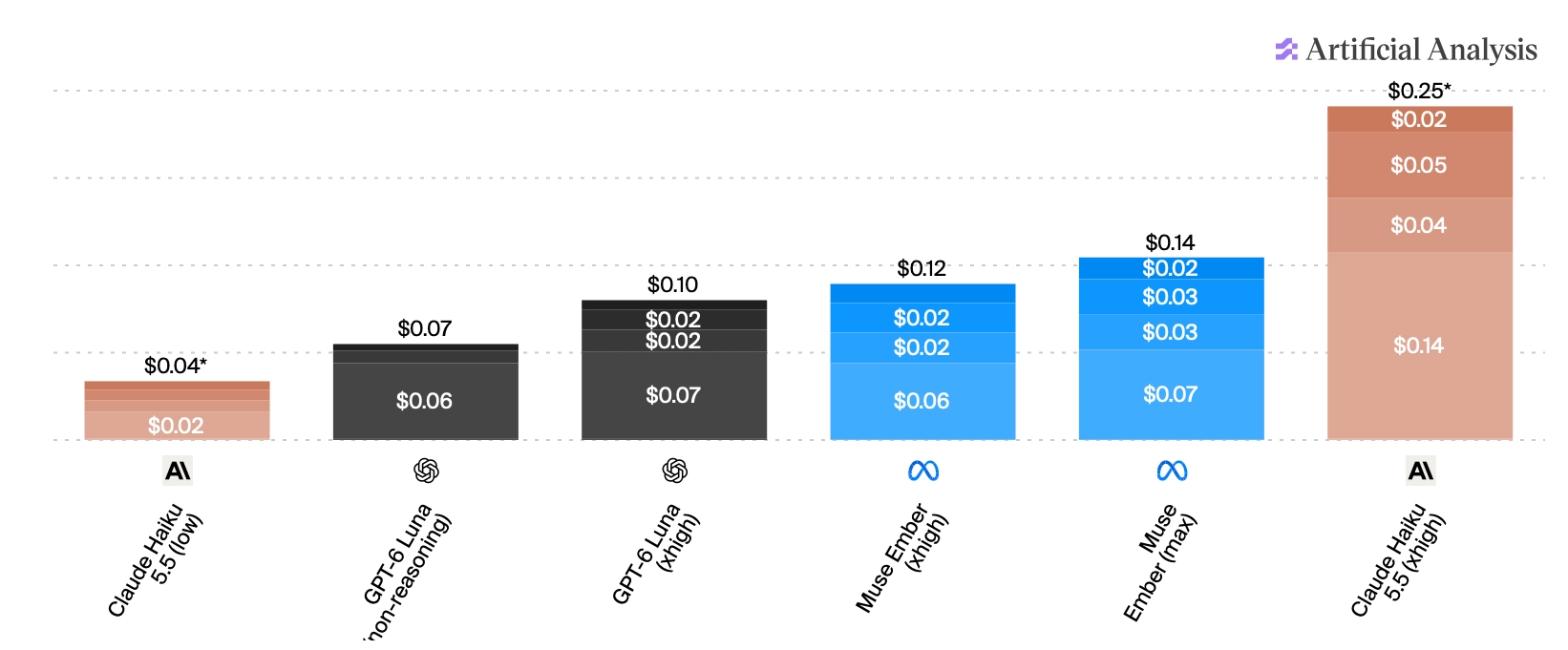
How this was written. GDS wrote this article with a language model from Simon Willison’s reporting (model: @cf/meta/llama-3.3-70b-instruct-fp8-fast); it describes that reporting rather than adding to it. The original, linked above, is the full story.
Key points from Simon Willison’s report
- Muse Ember is the smallest and most efficient model for complex tasks, offering high performance at a lower cost.
- The model's pricing is competitive with other models, such as GPT-6 Luna and Claude Haiku 5.5.
- Muse Ember sits on the efficiency frontier of the full Artificial Analysis leaderboard, making it a highly efficient option.
- The model's six reasoning levels offer flexibility and customization options.
- The development of Muse Ember has significant implications for the field of artificial intelligence.
Muse has introduced its smallest and most efficient model, Muse Ember, designed for complex reasoning execution and tasks such as tool calls, coding subtasks, and document parsing, according to Simon Willison. This model is significant as it offers high performance at a lower cost. The development of Muse Ember is a notable step in the field of artificial intelligence.
The pricing of Muse Ember is competitive with other models, such as GPT-6 Luna and Claude Haiku 5.5, with a cost of $0.10 per million input tokens and $0.50 per million output tokens for shorter prompts. However, the pricing becomes more complex for longer prompts, with a threshold after which the price increases. Simon Willison reported that Muse Ember's pricing is between that of GPT-6 Luna and Claude Haiku 5.5 for longer prompts.
The key details of Muse Ember's pricing are outlined in a comparison with other models, including GPT-6 Luna and Claude Haiku 5.5. The model supports up to a million input tokens, but the price increases after a certain threshold. For example, for prompts over 200k, the price of Muse Ember increases to $0.30 per million input tokens and $1.50 per million output tokens.
The performance of Muse Ember is notable, with the model sitting on the efficiency frontier of the full Artificial Analysis leaderboard. This means that no model scores higher for less per task, making Muse Ember a highly efficient option. The model's performance is also comparable to that of other models, such as Muse Wonder, which is 40x the price of Muse Ember.
The Intelligence Index vs. Cost per Task chart shows that Muse Ember sits on the Pareto line, the line at which you can only improve one dimension by giving up another. This indicates that Muse Ember offers a high level of performance at a lower cost. The model's six reasoning levels, ranging from minimal to max, also offer flexibility and customization options.
The development of Muse Ember has significant implications for the field of artificial intelligence, as it offers a high level of performance at a lower cost. This could lead to increased adoption and use of artificial intelligence in a variety of applications. As the field continues to evolve, the development of models like Muse Ember will be important to watch.
The next steps for Muse Ember will be important to watch, as the model is likely to have a significant impact on the field of artificial intelligence. With its high performance and lower cost, Muse Ember is likely to be widely adopted and used in a variety of applications. Simon Willison's report on Muse Ember provides valuable insights into the model's capabilities and potential impact.
Questions and answers
What is Muse Ember?
Muse Ember is the smallest and most efficient model for complex reasoning execution and tasks such as tool calls, coding subtasks, and document parsing.
How is Muse Ember priced?
Muse Ember is priced at $0.10 per million input tokens and $0.50 per million output tokens for shorter prompts, but the pricing becomes more complex for longer prompts.
How does Muse Ember perform compared to other models?
Muse Ember sits on the efficiency frontier of the full Artificial Analysis leaderboard, making it a highly efficient option, and its performance is comparable to that of other models, such as Muse Wonder, which is 40x the price of Muse Ember.