Simon Willison Identifies Key LLM Inflection Points
Simon Willison highlights three significant inflection points in LLM abilities over the past year, marking major advancements in coding agents and 3D modeling. These developments have significantly impacted the industry, enabling more efficient coding and game development.
Original reporting · simonwillison.net
Original: “Three LLM inflection points in twelve months”
Read “Three LLM inflection points in twelve months” at Simon Willison →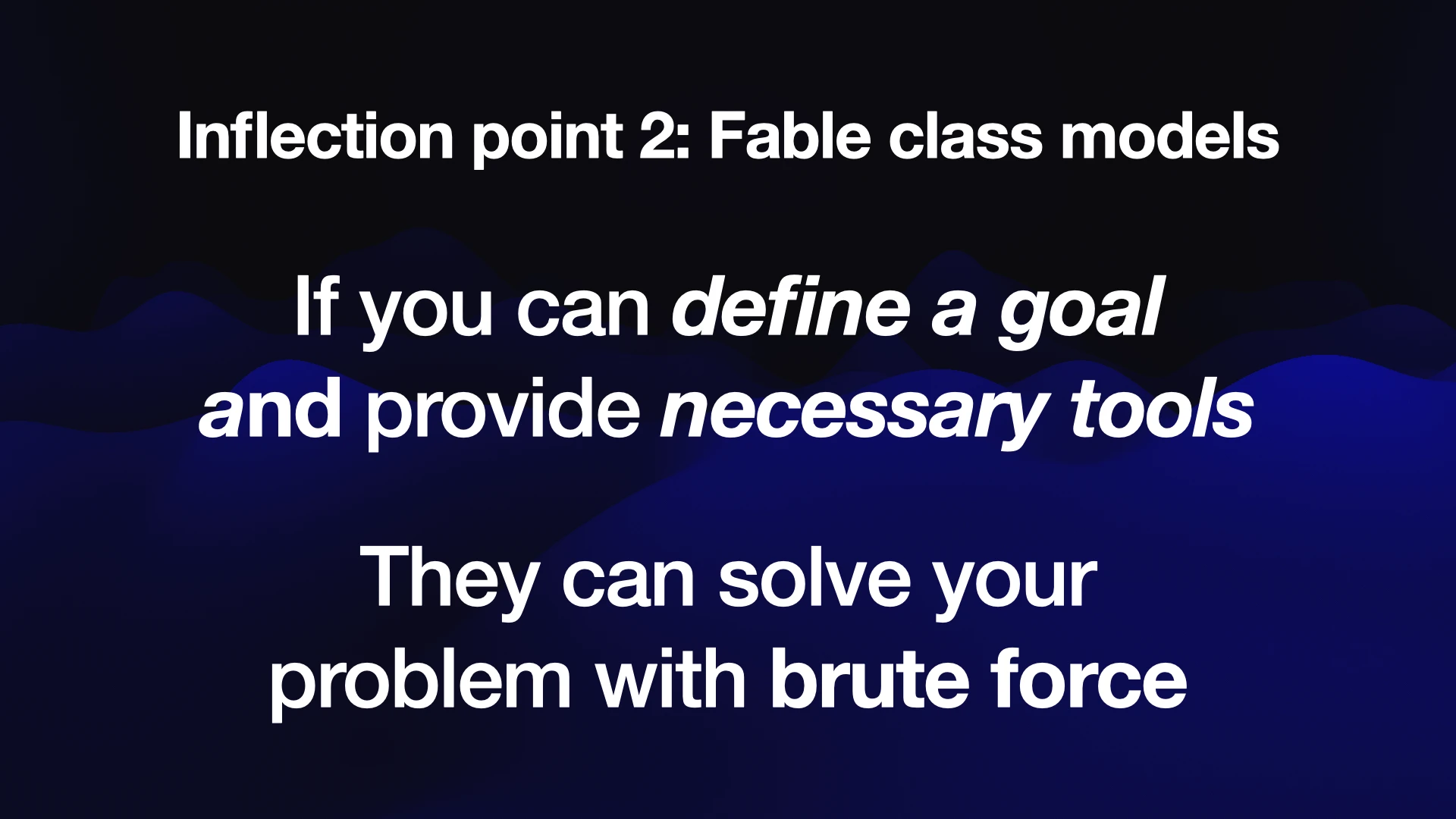
How this was written. GDS wrote this article with a language model from Simon Willison’s reporting (model: @cf/meta/llama-3.3-70b-instruct-fp8-fast); it describes that reporting rather than adding to it. The original, linked above, is the full story.
Key points from Simon Willison’s report
- Simon Willison has identified three significant inflection points in LLM abilities over the past year, marking major advancements in coding agents and 3D modeling.
- The release of Claude Opus 4.5 and OpenAI's GPT-5.1 models marked the first inflection point, enabling more efficient coding.
- The introduction of Fable class models, including Claude Fable 5, marked the second inflection point, demonstrating relentlessly proactive problem-solving capabilities.
- The ability of LLMs to understand and create engaging games has been a major breakthrough, with Claude Opus 5.5 demonstrating an understanding of what makes a game fun.
- The latest development, Fable 5.2, may represent another inflection point, enabling the rapid resolution of complex problems with a taste that almost exactly matches the user's.
Simon Willison, according to his recent keynote at the AI Engineer Code Summit, has identified three significant inflection points in the abilities of Large Language Models (LLMs) and coding agents over the past twelve months. These inflection points have marked major advancements in the field, enabling more efficient coding and game development.
The first inflection point occurred with the release of Claude Opus 4.5 in November 2025, which introduced a model that could handle ambiguity and reason about tradeoffs without hand-holding. This was followed by the release of OpenAI's GPT-5.1 models, which had a similar effect on their Codex coding agent, making it reliably useful for many coding tasks.
The second inflection point came with the introduction of Fable class models in June and July 2026. These models, including Claude Fable 5, were relentlessly proactive and could solve complex problems. However, the US government initially placed Fable 5 under export controls, limiting its availability. The model was later released, and its capabilities have been further enhanced with subsequent updates.
The third inflection point occurred in September and October 2026, when frontier LLMs became proficient in 3D modeling. Models such as Claude Fable 5, Opus 5.5, and GPT-6 Astra could produce credible models of almost anything asked of them. This development has significant implications for robotics and game development, as 3D spatial awareness is crucial for vision LLMs.
The ability of LLMs to understand and create engaging games has also been a major breakthrough. Claude Opus 5.5, in particular, has demonstrated an understanding of what makes a game fun, and its capabilities have been showcased in several game projects. This has led to a culture war in the indie games scene, with some calling GTA VI the last pre-generative AI blockbuster.
The latest development, Fable 5.2, may represent another inflection point, as it seems to have a taste that almost exactly matches the user's, enabling the rapid resolution of complex problems. However, it is still unclear whether this represents a new inflection point or just an incremental improvement. The release of Fable 5.2 has led to a flood of fixes, features, and improvements in various software projects, demonstrating its potential to significantly impact the industry.
The advancements in LLMs have significant implications for the future of coding and game development. As these models continue to improve, they are likely to have a major impact on the industry, enabling more efficient and creative development of software and games. The ability of LLMs to understand and create engaging games, in particular, has the potential to revolutionize the gaming industry.
The inflection points identified by Simon Willison highlight the rapid progress being made in the field of LLMs. As these models continue to evolve, it is likely that we will see even more significant advancements in the future, leading to major changes in the way we approach coding and game development.
Questions and answers
What are the three inflection points in LLM abilities identified by Simon Willison?
The three inflection points are the release of Claude Opus 4.5 and OpenAI's GPT-5.1 models, the introduction of Fable class models, and the ability of LLMs to understand and create engaging games.
What is the significance of Fable class models?
Fable class models, including Claude Fable 5, are relentlessly proactive and can solve complex problems, demonstrating a significant advancement in LLM capabilities.
How have LLMs impacted the gaming industry?
LLMs, such as Claude Opus 5.5, have demonstrated an understanding of what makes a game fun, leading to a culture war in the indie games scene and potentially revolutionizing the gaming industry.