Simon Willison Develops External Sandboxes For Coding Agents
Simon Willison has introduced external sandboxes for coding agents, making it safer to try out local models. This development aims to prevent mistakes or prompt injection attacks from causing damaging actions on a machine.
Original reporting · simonwillison.net
Original: “External sandboxes for coding agents”
Read “External sandboxes for coding agents” at Simon Willison →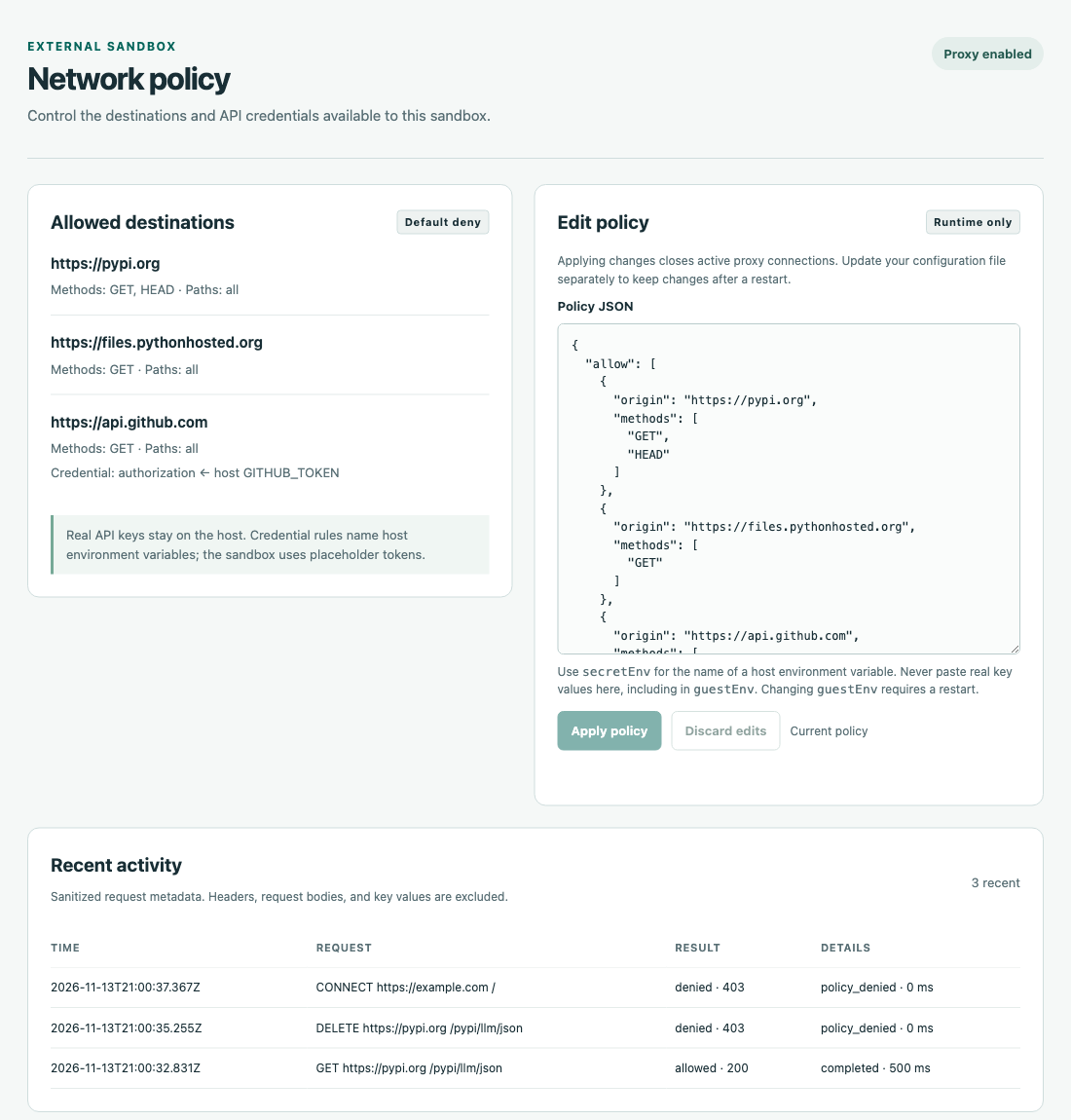
How this was written. GDS wrote this article with a language model from Simon Willison’s reporting (model: @cf/meta/llama-3.3-70b-instruct-fp8-fast); it describes that reporting rather than adding to it. The original, linked above, is the full story.
Key points from Simon Willison’s report
- Simon Willison has introduced the external sandbox pattern for coding agents to improve safety
- The pattern involves running code executed by the agent inside a dedicated sandbox
- Three sandbox server implementations have been released, offering the same localhost API
- The sandboxes include an optional HTTP/HTTPS allow-list proxy and credential replacement mechanism
- Simon Willison's work on external sandboxes is part of his exploration of safely running untrusted code
Simon Willison, according to his blog post, has been exploring new ways to sandbox code executed by agents, with a focus on safety. This project was worked on with Prime Radiant, the AI research lab behind Superpowers and other projects. The goal is to make it safer to try out local models without worrying about potential risks.
The external sandbox pattern, as introduced by Simon Willison, involves running code executed by the agent inside a dedicated sandbox while the agent itself lives outside of that sandbox. This pattern is demonstrated through three sandbox server implementations. These implementations offer a way to control the execution of code and prevent potential damages.
The three sandbox server implementations released are external-sandbox-v86, external-sandbox-container, and external-sandbox-quicksand. Each of these implementations offers the same localhost API, allowing for configuration with Pi, Claude Code, or Codex to send API calls to the sandbox. This provides a flexible way to execute code while maintaining safety measures.
The sandboxes also include an optional HTTP/HTTPS allow-list proxy, which enables control over exactly which hosts the agent's code is allowed to communicate with. Additionally, a credential replacement mechanism is included to make authenticated API calls without sharing a secret with the agent. This provides an extra layer of security and control.
Simon Willison's work on the external sandbox pattern is part of his ongoing exploration of safely running untrusted code. This development provides a neat way to experiment with different approaches to sandboxing code. The introduction of these sandboxes is a significant step towards improving the safety of coding agents.
The external sandbox pattern has the potential to impact the way coding agents are used and developed. By providing a safer way to execute code, this pattern can help prevent mistakes and prompt injection attacks. As the use of coding agents continues to grow, the development of external sandboxes is an important step towards ensuring their safe and reliable operation.
Questions and answers
What is the purpose of the external sandbox pattern?
The purpose of the external sandbox pattern is to make it safer to try out local models without worrying that a mistake or prompt injection attack might cause damaging actions on a machine.
What are the three sandbox server implementations released?
The three sandbox server implementations released are external-sandbox-v86, external-sandbox-container, and external-sandbox-quicksand.
What is the benefit of the optional HTTP/HTTPS allow-list proxy?
The optional HTTP/HTTPS allow-list proxy enables control over exactly which hosts the agent's code is allowed to communicate with, providing an extra layer of security and control.